Skip to content
Remote gambling in Singapore means gambling conducted through remote communication rather than requiring participants to be physically present at the same venue. In practice, that covers websites, mobile apps and other internet-based services.
Singapore regulates it under the Gambling Control Act 2022, where the default rule is that gambling is prohibited unless licensed or exempted. The Gambling Regulatory Authority (GRA) states that Singapore Pools is the only operator licensed by GRA to provide remote gambling services in Singapore.
The reach of that rule is what catches most people out. It is unlawful to provide unlicensed remote gambling services in Singapore, from Singapore, or from overseas to people located in Singapore. What determines whether Singapore’s law applies is where the user sits, not where the company, licence or server sits.
For the wider topic, read our Online Gambling Singapore Guide.
Quick Answer
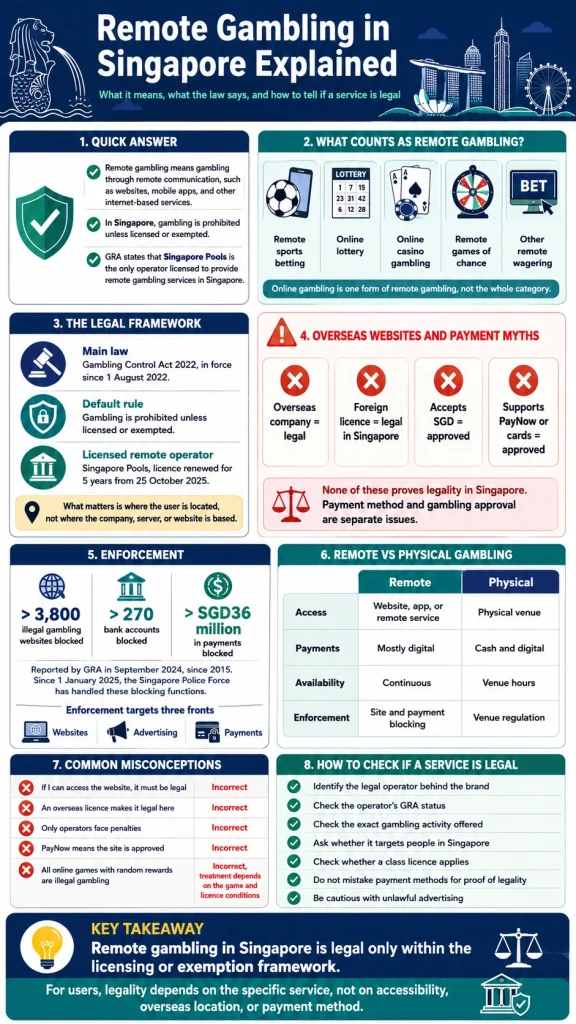
Remote gambling is not open to any operator that wants to offer it. An activity must fall within Singapore’s licensing or exemption framework, and GRA identifies Singapore Pools as the only licensed remote gambling operator.
An overseas website does not become legal for Singapore users because it operates from another country. The framework explicitly covers gambling facilities sitting outside, or partly outside, Singapore.
What Is Remote Gambling?
Remote gambling describes gambling carried out without everyone involved being physically present in the same place: websites, mobile apps, remote sports betting, online lottery participation, and other internet-based wagering.
Online gambling is therefore one form of remote gambling, not a synonym for it. The regulatory term is broader because it focuses on how the activity is provided rather than on whether a conventional website is involved. That breadth is deliberate, since a definition tied to “websites” would age badly as technology changes while one tied to remote communication does not.
If you want the basic definition first, read What Is Online Gambling?
Which Law Covers Remote Gambling in Singapore?
Remote gambling sits within the Gambling Control Act 2022 framework, in force since 1 August 2022. GRA exercises its powers under that Act alongside the Gambling Regulatory Authority Act 2022 and the Casino Control Act 2006.
Singapore previously regulated this area through the separate Remote Gambling Act 2014. The Gambling Control Act consolidated it into a single structure covering physical and remote gambling together, and the government confirmed during its passage that the new framework would continue to cover unlawful remote gambling, including cases where facilities sit outside or partly outside Singapore.
Nothing was loosened in that reorganization. Remote gambling is not a carve-out from the wider framework, and repealing the older Act did not create a gap.
For the broader legal structure, read Singapore Gambling Laws Explained.
Is Remote Gambling Legal in Singapore?
Remote gambling is permitted only where the activity falls within the licensing or exemption framework, and Singapore Pools is the only licensed operator. GRA renewed its licence to conduct betting operations, gaming and lotteries for five years from 25 October 2025.
This reframes the question worth asking. “Is remote gambling legal?” has no useful answer. “Is this specific service licensed or exempted for use in Singapore?” does.
For the dedicated legality guide, read Is Online Gambling Legal in Singapore?
Are Overseas Websites and Foreign Licences Legal Here?
No, and both fail for the same reason: neither says anything about Singapore permission.
GRA states that it is unlawful to provide unlicensed remote gambling services from outside Singapore to people situated in Singapore. A foreign licence shows an operator is regulated under another jurisdiction’s rules, which is a fact about that jurisdiction, not this one.
None of the following establishes legality:
The company is registered overseas. The website holds an overseas licence. The servers are outside Singapore. The site accepts Singapore users. The site accepts SGD. The site supports a familiar payment method.
Payment familiarity is the most persuasive false signal of the lot. A platform might accept PayNow, bank transfers, cards or e-wallets without any of it establishing approval. There is a practical risk the other way too: payment services connected to illegal gambling are an active enforcement target, so a route working today is no guarantee it works tomorrow.
For a payment-specific comparison, read PayNow vs Other Payment Methods.
Can Players Break the Law by Using Unlicensed Services?
Yes. Singapore’s framework does not apply only to operators.
When introducing the Gambling Control Act, the government stated that unlawful gambling offences apply across the chain, covering operators, agents and individual punters. Assuming only the website faces consequences is the most consequential misreading of this framework.
How Are Unlawful Remote Gambling Services Controlled?
Enforcement targets three fronts at once: the websites, the advertising, and the money.
GRA reported in September 2024 that more than 3,800 illegal gambling websites, over 270 bank accounts and more than SGD36 million in payments linked to illegal remote gambling had been blocked since 2015. Since 1 January 2025, the Singapore Police Force has handled these blocking functions.
Advertising is covered too. GRA states that advertising unlawful gambling in Singapore, from Singapore, or from outside Singapore into Singapore is an offence. A social media advertisement is therefore not evidence the advertised service is lawful, and aggressive marketing into Singapore is a signal worth treating with suspicion rather than reassurance.
What Types of Gambling Count as Remote Gambling?
| Remote Gambling Type | Typical Format |
|---|---|
| Remote sports betting | Wagering on sporting events through an online service |
| Online lottery | Entering lottery products remotely |
| Online casino gambling | Casino-style games through an online platform |
| Remote games of chance | Chance-based games offered through digital systems |
| Remote wagering | Other bets placed through remote communication |
Legal treatment differs by activity. GRA operates a separate class licensing framework for certain remote games with chance-based elements where users might win money, money equivalents or other items of value, with loot boxes given as an example.
That structure is not general approval for online casino gambling. Different products sit under different arrangements, and permission granted for one does not extend to another.
For a breakdown of gambling categories, read Types of Online Gambling Explained.
How Remote Gambling Differs From Physical Gambling
| Area | Remote Gambling | Physical Gambling |
|---|---|---|
| Access | Website, app or remote service | Physical venue |
| Location | User and operator need not be together | User visits venue |
| Payments | Mostly digital | Cash and digital methods |
| Availability | Continuous | Depends on venue hours |
| Regulatory concern | Cross-border access, websites, payments | Venue licensing and entry controls |
| Enforcement | Includes site and payment blocking | Includes venue regulation |
Availability is the difference that matters most in practice. A venue closes and requires a journey to reach, while a remote service does neither. That is why account-level controls such as spending limits and exclusion programmes carry more weight here than any physical restriction can.
The National Council on Problem Gambling provides self-exclusion and gambling harm services, including exclusion options covering Singapore Pools online betting. These protections exist because the activity is regulated, and they have no equivalent on an unlicensed offshore site.
For the dedicated guide, read Responsible Gambling Singapore.
Common Misconceptions
"If I can access the website, it must be legal."
Incorrect. Accessibility is a technical fact, never a regulatory one.
"An overseas licence makes remote gambling legal in Singapore."
Incorrect. The framework applies to unlicensed services supplied from overseas to people located here.
"Only operators face penalties."
Incorrect. Unlawful gambling offences also apply to individual participants.
"PayNow means the website is approved."
Incorrect. Payment availability and gambling licensing are entirely separate matters.
"All online games with random rewards are illegal gambling."
Incorrect. Some remote games of chance operate under class licence conditions, and treatment depends on the game and whether those conditions are met.
How to Check Whether a Service Is Legal
| Check | Question to Ask |
|---|---|
| Operator | Who is the legal entity behind the brand name? |
| GRA status | Is that operator licensed? |
| Gambling type | Which specific activity is being offered? |
| Overseas operation | Is it targeting people in Singapore? |
| Class licence | Does a specific class licence apply? |
| Payment | Is a payment method being mistaken for proof of legality? |
| Advertising | Is the service being promoted unlawfully? |
Work through these in order, starting with GRA’s own information rather than the operator’s website. Identifying the operator comes first because a brand name and the legal entity behind it are frequently different, and a licence may cover only certain activities rather than everything the site offers.
For more website checks, read How to Verify an Online Casino.
Why a PayNow Payment May Not Show Up
Sometimes the bank shows a completed PayNow transaction while the merchant account still shows no payment.
This often means the delay is happening on the receiving side rather than inside PayNow itself.
Possible reasons include:
- Manual payment matching
- Missing transaction reference
- Incorrect amount
- Account verification
- Payment processing queues
- Platform maintenance
Keep the transaction reference and payment confirmation. These details help the receiving platform trace the transfer.
Read Why Is My PayNow Deposit Not Showing? for a detailed troubleshooting guide.
Using PayNow for Online Casino Payments
Some online gaming platforms offer PayNow for deposits because it provides a direct local payment option for Singapore users.
The basic process is similar to other PayNow online payments:
- Select PayNow.
- Enter the deposit amount.
- Scan the PayNow QR or use the payment information.
- Confirm the recipient.
- Approve the payment.
- Wait for the platform to credit the balance.
The platform’s processing system determines how quickly the deposit appears after the bank transfer is completed.
Read How to Deposit Using PayNow at an Online Casino for the full process.
Frequently Asked Questions
What is remote gambling?
Remote gambling is gambling conducted through remote communication rather than requiring physical presence at the venue. Online gambling is one common form of it.
Is remote gambling legal in Singapore?
Only within the licensing or exemption framework. GRA states that Singapore Pools is the only operator licensed by GRA to provide remote gambling services in Singapore.
Are overseas online gambling websites legal in Singapore?
No. GRA states that providing unlicensed remote gambling services from outside Singapore to people situated in Singapore is unlawful, regardless of where the operator is based.
What law regulates remote gambling in Singapore?
The Gambling Control Act 2022, which consolidated the earlier Remote Gambling Act 2014. GRA also exercises powers under the Gambling Regulatory Authority Act 2022 and the Casino Control Act 2006.
Does an overseas gambling licence make a website legal in Singapore?
No. Singapore applies its own requirements to remote gambling services supplied to people located here, and a foreign license does not substitute for Singapore approval.